
In This Issue
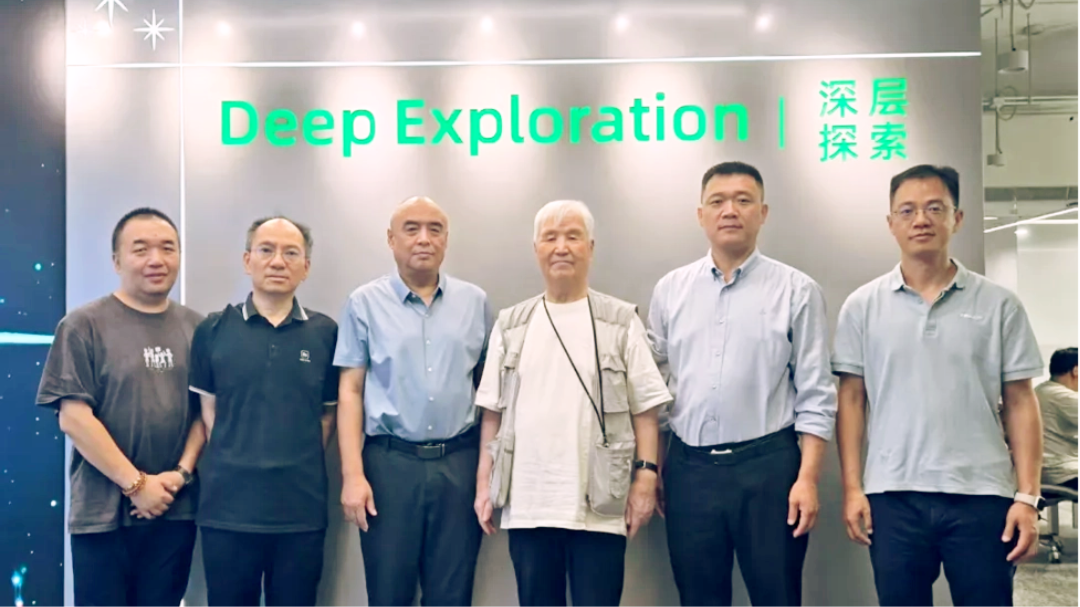
We have all heard plenty about quantum computing and quantum communication — but can quantum physics help us find minerals underground? Last week, Professor Song Kongzhi of the Beijing Aerospace Medicine Engineering Institute (commonly known as Institute 507) brought decades of experience in ultra-weak signal detection for aerospace medicine to Deep Exploration. Two fields met on the same technical proposition, and a cross-disciplinary dialogue between aerospace medicine and deep prospecting began.
What Is "Quantum," Really?
First, one clarification: quantum is neither a material nor a machine. It is the fundamental framework of physics for describing the microscopic world. In the quantum realm, particles behave in ways utterly unlike our everyday experience — they can exist in multiple states simultaneously, become correlated across vast distances, and persist as extraordinarily weak signals. These counter-intuitive properties are precisely where the value of quantum technology lies.
By analogy: if conventional measurement is like looking at things through a magnifying glass, quantum measurement is more like standing in a pitch-black room and sensing the vibration of a single speck of dust in the air to judge whether something sits in the corner. The order of precision is entirely different. Ultra-weak signals emitted by minerals hundreds of meters underground are, by the time they reach the surface, so faint they are nearly drowned out by background noise — like trying to hear an ant's footsteps in a room hosting a rock concert.

Quantum Sensing: From Lab to Application
Over the past two decades, quantum technology has moved from the laboratory toward application — quantum communication networks have been built, and quantum computers are now running algorithms. In more "down-to-earth" domains, quantum sensing is opening a new door: using the properties of microscopic particles to detect ultra-weak signals in the macroscopic world.
For instance: might minerals hundreds of meters beneath the surface emit some signal inaudible to the human ear, yet potentially capturable by instruments at the quantum scale?
Institute 507: From Aerospace Medicine to Frontier Science
Institute 507 may sound unfamiliar, but its pedigree is formidable. Originally the "Institute of Space Medicine and Engineering," it was founded in April 1968 under the China Academy of Space Technology (the Fifth Academy), then headed by Qian Xuesen as president. In the planning of China's manned space program, Institute 507 carried out comprehensive aerospace-medical research and participated in the selection, training, and preparation of astronauts.
Institute 507 faced several dissolution crises. Qian Xuesen fought to preserve it: "For the nation's future development of manned spaceflight, the staff may be reduced, but this institution must not be dissolved." — Qian Xuesen, 1986
What makes Institute 507 unique is that it has always stood at the frontier of a single proposition: how humans adapt to extreme environments. From the effects of space weightlessness on the human body to the patterns of physiological change under extreme conditions, its research sits naturally at the intersection of disciplines — biology, physics, medicine, and engineering collide here.
Professor Song Kongzhi himself graduated in physiology from Peking University's Department of Biology in 1963 and spent decades in aerospace-medicine pre-research at Institute 507. What he brings is not a specific device or algorithm, but a cross-disciplinary way of thinking — the underlying methodology of "ultra-weak signal detection" is common across different physical scenarios.

A Cross-Disciplinary Dialogue
Returning to last week's exchange: Institute 507's research direction — from aerospace medicine to human science under extreme conditions — and Deep Exploration's technology roadmap seem, at first glance, far apart. One is up in the sky, the other deep underground. But the micro-particle field is precisely a bridge connecting the two.
Deep Exploration's core technical path is "AI + satellite remote sensing + ultra-weak NMR prospecting." Its "targeted ultra-weak NMR" technology is, in essence, penetrating the surface to detect the micro-particle-field information of minerals buried deep underground — itself a manifestation of quantum mechanics in the macroscopic world.
What Institute 507 has accumulated in aerospace medicine is precisely the ability to detect and analyze "extremely weak physiological signals under extreme conditions" — from the subtlest physiological changes in astronauts under weightlessness to the electromagnetic-signal characteristics of the human body in special states. This methodology of "extracting ultra-weak signals from noise" shares a natural overlap with the application of targeted ultra-weak NMR prospecting.
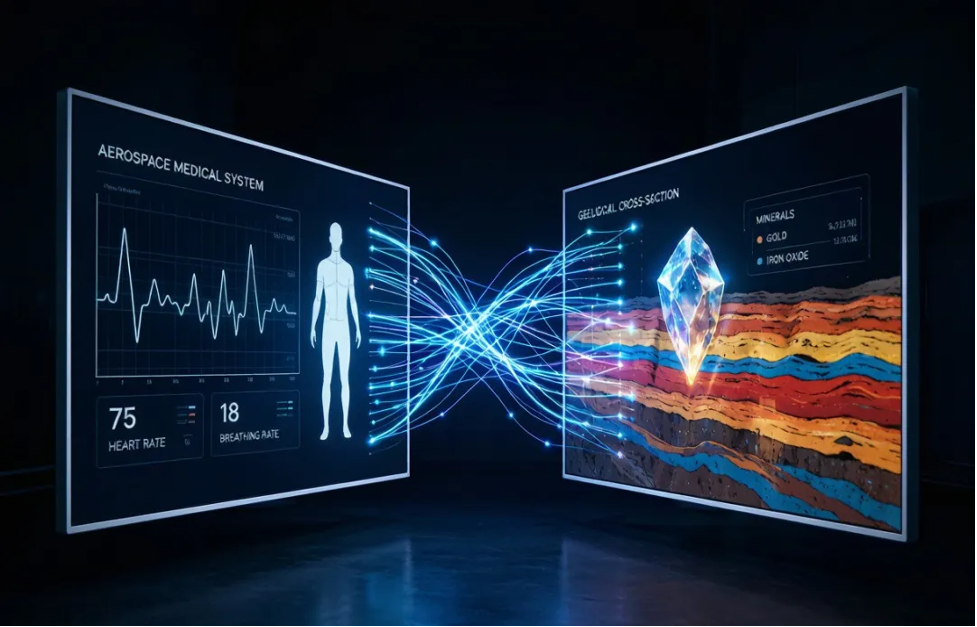
During the exchange, the two sides discussed the prospects of quantum-sensing technology in geological detection, the methodological commonalities of ultra-weak signal detection, and approaches to cross-analyzing aerospace-medicine data with geological data. The signal-processing experience Institute 507 has built over decades in aerospace-medicine scenarios may offer new entry points for Deep Exploration's ultra-weak NMR signal processing.
Why It Matters
First, cross-disciplinary convergence. Aerospace medicine and deep prospecting — two seemingly unrelated fields — found a common language at the intersection of "quantum-level ultra-weak signal detection." Throughout the history of science, many breakthroughs have occurred precisely at disciplinary boundaries.
Second, direction. Quantum sensing is currently a hot topic in global physics, yet the vast majority of research concentrates on quantum communication and quantum computing. Bringing quantum-sensing thinking down to geological detection — to "listen" for underground minerals — remains a rarely traveled road.
In Summary
Quantum prospecting is not an answer; it is an inspiration. Returning to the opening question — can quantum physics help us find minerals underground? Deep Exploration has already put this into practice in specific projects, and Institute 507 has been exploring along the same road. This exchange, more than delivering a verdict, was an experiment — letting the methodologies of two fields meet and seeing what emerges.
- Aerospace medicine × deep prospecting: a shared intersection on "quantum-level ultra-weak signal detection"
- Ultra-weak NMR prospecting: leveraging the quantum behavior of atomic nuclei to "see" underground minerals without drilling
- Direction of change: pushing detection depth from shallow to mid-to-deep layers, moving "seeing underground without drilling" toward engineering deployment